
What Rebuilding Our Own Website Taught Me About Every Business Website
Website DesignWebsite Redesign
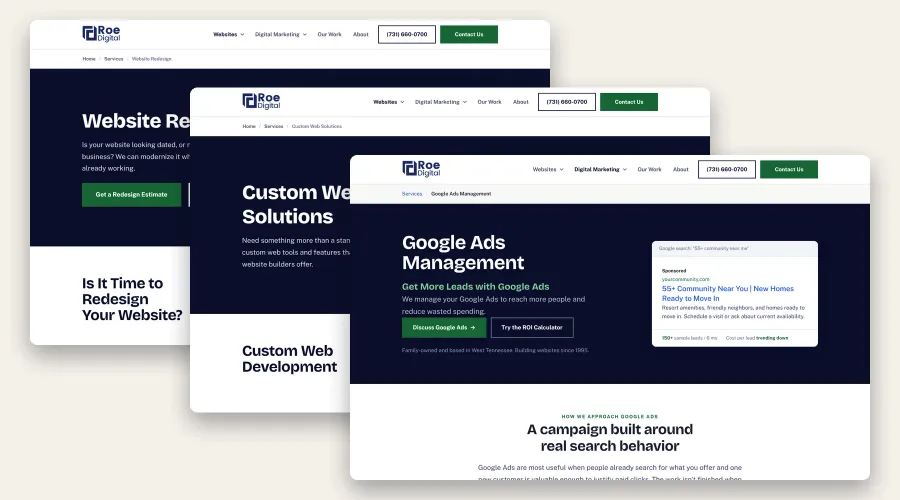
If you’re reading this on our new website, welcome. This project had been on my list for years.
Like many business owners, I spend most of my time helping clients. Between building websites, managing digital marketing campaigns, improving SEO, monitoring advertising, answering questions, and keeping up with technology, my own website always got pushed to “when things slow down.” Of course, things never really slow down.
The website we launched years ago had served us well, and at the time I was proud of it. But over the years I found myself making little updates here and there while putting off the bigger improvements I knew it needed. Eventually I realized our website no longer reflected who Roe Digital had become. If you’ve ever looked at your own website and thought, “We really need to update this,” you’re not alone. I’ve been there too.
Here is what the rebuild involved, what it taught me, and the one thing I got wrong.
The rebuild at a glance
| Before | After | |
|---|---|---|
| Platform | WordPress with a page builder and plugins | Astro static site on Cloudflare |
| Content | A decade of pages and posts, many on topics unrelated to our services | Pages and posts focused on websites, search, and ads |
| Old addresses | None redirected | 108 mapped: 99 redirected to a replacement page, 9 retired on purpose (as of October 2026) |
| Routine updates | WordPress core, theme, and plugin updates every week | No WordPress updates; code, forms, and hosting still reviewed |
| Free tools | None | Pricing estimator, Google Ads cost calculator, vacancy calculator, free website audit |
Looking at our business through fresh eyes
When I finally committed to rebuilding the website, I assumed the biggest challenge would be choosing a new design. I was wrong. The biggest challenge was deciding what deserved to stay.
As I worked through the site, I kept finding pages that made me stop and think. Some described services we had refined over the years. Some answered questions our clients weren’t really asking anymore. Some reflected where our business had been five or six years ago instead of where it is today. The content wasn’t necessarily wrong. It simply wasn’t us anymore.
That became the theme of the entire project. Instead of asking, “How do I move this page to the new website?” I started asking, “Does this page still deserve to exist?”
Letting the data guide the decisions
Before removing a single page, I wanted to know how people were actually using the website. So I spent hours in Google Search Console, going back through years of data page by page.
Some pages I assumed were no longer important were still bringing visitors from Google. Others hadn’t received meaningful traffic in years. A few were getting a lot of impressions from searches that had nothing to do with hiring a web design company, such as articles on making money online and AI image generators, which is a different kind of problem. Instead of making decisions based on opinions, I let the data make the first cut and then applied judgment to what was left.
That process changed several assumptions I had going into the project. Some pages stayed because they were still valuable. Others were combined, rewritten, or removed because they no longer supported where Roe Digital is headed. It is the first thing I want to look at when we start a website redesign for a client, whenever the client can give us access to their search data. If you are comparing companies for your own project, our guide to choosing a website redesign company explains what to ask about it.
Getting clear about our focus
One of the biggest lessons from this project was realizing that a website doesn’t have to talk about everything you’ve ever done. In fact, it probably shouldn’t.
Over the years we had written about a wide variety of topics. Some of them were useful. Some had generated search traffic. But they weren’t helping people understand what Roe Digital does best today. As we rebuilt the site, we intentionally narrowed our focus to what we want to be known for: websites, search optimization for Google and AI search, Google Ads, and ongoing digital marketing for the industries we know well.
Removing content wasn’t about losing information. It was about creating clarity.
Watching the data after launch
Launch is not the finish line. The first few weeks of data show what you got right and what needs refining, and that review never really stops.
In our case, the drop in Search Console was hard to miss. In June 2026, the month before launch, the site was showing up in roughly 300 to 500 Google searches a day. By August through October, that was down to roughly 50 to 150 a day. Clicks had been small before and stayed small, so the real change was how often Google showed us at all.
Most of what we lost was visibility we didn’t want: the off-topic articles that drew impressions from people who were never going to hire a web design company. Some of it, though, was visibility I should have protected. One example is an older article about what to consider before hiring someone to redesign your website. In the first half of 2026 it had been appearing on the first or second page of Google for searches like “how to hire someone to redesign my website.” I had retired it and pointed its address at a service page that didn’t answer that question, and the impressions for those searches fell off. I can’t prove the redirect alone caused the drop, but the pattern fits, and it is the mistake I’d most like to spare you.
The fix is slow and not guaranteed: write a better version of the article, publish it on the new site, and point the old address at the new article instead of at a service page. The first of those, a guide to choosing a website redesign company, is live, with more planned. A restored article has to earn its place again; Google does not simply hand back the old rankings.
The lesson for anyone planning a redesign: a page that looks dated to you may be a page Google trusts. Decide what to cut from the search data, not from the design. When you do retire a page, redirect it to the closest matching content rather than to the homepage or a catch-all service page, and understand that even a good redirect does not guarantee the visibility carries over.
Building the resources I’d wanted to build for years
One part of the new website that I’m especially excited about is something many people may never think twice about: the calculators.
They had been on my “someday” list for a long time and kept getting pushed behind client work. This rebuild finally gave me the opportunity to build tools that help business owners answer common questions on their own: a pricing estimator that shows a price range before asking for your contact information, a Google Ads cost calculator that looks up what clicks typically cost in your market and what an ad budget could buy, a vacancy cost calculator for RV parks and communities, and a free website audit that checks a site’s speed, SEO basics, and accessibility basics.
Whether someone becomes a client or not, I want the Roe Digital website to be genuinely useful. If we can help someone better understand a project, estimate a budget, or make a more informed decision, that’s a win. I plan to keep adding resources like these.
More than a new design
While the design certainly changed, this project was never really about making the website look newer. It was about building a better foundation.
Along the way we moved off WordPress to a static site, so our pages load without a database or a page builder in the way. We reviewed accessibility throughout the site, simplified the navigation, rewrote nearly every page, optimized images, and mapped every old address we could find to a replacement.
The maintenance changed too, and this is the part business owners ask about most. On WordPress, keeping the site healthy meant core, theme, and plugin updates nearly every week, and each one carried a small chance of breaking something. The new site has none of that. It still needs oversight, because the code and the tools it is built with get updates, the forms and integrations need checking, and the hosting has settings to keep an eye on. But that is a periodic review rather than a weekly chore, and it is the approach we now take with the sites we build for clients.
Many of these improvements aren’t things visitors consciously notice. Together, though, they make a site that is easier to use and maintain, and better prepared for the way people search now, including AI search tools.
The lesson that hit home
The biggest thing this project reminded me of is something I often tell clients: a website is never truly finished. It should evolve as your business evolves.
Technology changes. Search engines change. Accessibility expectations improve. Security standards continue to evolve. Most businesses don’t wake up one day with an outdated website. It happens gradually, one small update at a time, one postponed project at a time, one busy season at a time, until eventually the website no longer represents the business you’ve worked so hard to build.
Looking ahead
Launching this new website was the beginning of the next chapter, not the end of the project. We’ll continue improving it, measuring what works, adding helpful resources, bringing back the articles that deserved to stay, and making thoughtful updates over time. That’s the same approach we take with clients, and it’s what our website maintenance plans exist to support.
If there’s one thing this project reinforced for me, it’s this: your website should represent the business you are today, not the business you were five years ago. If you’re starting to feel like your own website no longer tells the right story, run it through our free website audit or talk with us about where to start.